import sympy as sp
import matplotlib.pyplot as plt
import numpy as np
from IPython.display import Math, display
from symbolic_fem_workbench.reference import (
    ReferenceTriangleP1, ReferenceQuadrilateralQ1, ReferenceQuadrilateralQ2,
    ReferenceTetrahedronP1, ReferenceTetrahedronP2, ReferenceHexahedronQ1,
)6 Reference Element Gallery
This notebook showcases the reference elements that form the building blocks of finite element analysis. Each reference element is defined on a standard domain (e.g., the unit triangle or unit square) and provides shape functions that are mapped to physical elements via Jacobian transformations.
6.1 2D Elements
6.1.1 Triangle P1 (Linear Triangle)
xi, eta = sp.symbols("xi eta")
tri = ReferenceTriangleP1(xi, eta)

print("=== Triangle P1 ===")
print(f"Nodes: {tri.nodes}")
print(f"Number of nodes: {len(tri.nodes)}")
for i, N in enumerate(tri.shape_functions):
    display(Math(f"N_{{{i+1}}} = " + sp.latex(N)))
print(f"Partition of unity: {sp.simplify(sum(tri.shape_functions))}")

# Kronecker delta check
print("\nKronecker delta property (N_i(node_j) = delta_ij):")
for i, node in enumerate(tri.nodes):
    vals = [sp.simplify(N.subs({xi: node[0], eta: node[1]})) for N in tri.shape_functions]
    print(f"  N(node {i+1}) = {vals}")
=== Triangle P1 ===
Nodes: ((0, 0), (1, 0), (0, 1))
Number of nodes: 3\(\displaystyle N_{1} = - \eta - \xi + 1\)
\(\displaystyle N_{2} = \xi\)
\(\displaystyle N_{3} = \eta\)
Partition of unity: 1

Kronecker delta property (N_i(node_j) = delta_ij):
  N(node 1) = [1, 0, 0]
  N(node 2) = [0, 1, 0]
  N(node 3) = [0, 0, 1]
6.1.2 Quadrilateral Q1 (Bilinear Quad)
quad1 = ReferenceQuadrilateralQ1(xi, eta)
print("=== Quadrilateral Q1 ===")
print(f"Nodes: {quad1.nodes}")
for i, N in enumerate(quad1.shape_functions):
    display(Math(f"N_{{{i+1}}} = " + sp.latex(N)))
print(f"Partition of unity: {sp.simplify(sum(quad1.shape_functions))}")

# Kronecker delta
print("\nKronecker delta property:")
for i, node in enumerate(quad1.nodes):
    vals = [sp.simplify(N.subs({xi: node[0], eta: node[1]})) for N in quad1.shape_functions]
    print(f"  N(node {i+1}) = {vals}")
=== Quadrilateral Q1 ===
Nodes: ((-1, -1), (1, -1), (1, 1), (-1, 1))\(\displaystyle N_{1} = \frac{\left(\eta - 1\right) \left(\xi - 1\right)}{4}\)
\(\displaystyle N_{2} = - \frac{\left(\eta - 1\right) \left(\xi + 1\right)}{4}\)
\(\displaystyle N_{3} = \frac{\left(\eta + 1\right) \left(\xi + 1\right)}{4}\)
\(\displaystyle N_{4} = - \frac{\left(\eta + 1\right) \left(\xi - 1\right)}{4}\)
Partition of unity: 1

Kronecker delta property:
  N(node 1) = [1, 0, 0, 0]
  N(node 2) = [0, 1, 0, 0]
  N(node 3) = [0, 0, 1, 0]
  N(node 4) = [0, 0, 0, 1]
6.1.3 Quadrilateral Q2 (Biquadratic Quad)
quad2 = ReferenceQuadrilateralQ2(xi, eta)
print("=== Quadrilateral Q2 ===")
print(f"Nodes: {quad2.nodes}")
print(f"Number of nodes: {len(quad2.nodes)}")
for i, N in enumerate(quad2.shape_functions):
    display(Math(f"N_{{{i+1}}} = " + sp.latex(sp.simplify(N))))
=== Quadrilateral Q2 ===
Nodes: ((-1, -1), (0, -1), (1, -1), (1, 0), (1, 1), (0, 1), (-1, 1), (-1, 0), (0, 0))
Number of nodes: 9\(\displaystyle N_{1} = \frac{\eta \xi \left(\eta - 1\right) \left(\xi - 1\right)}{4}\)
\(\displaystyle N_{2} = - \frac{\eta \left(\eta - 1\right) \left(\xi^{2} - 1\right)}{2}\)
\(\displaystyle N_{3} = \frac{\eta \xi \left(\eta - 1\right) \left(\xi + 1\right)}{4}\)
\(\displaystyle N_{4} = - \frac{\xi \left(\eta^{2} - 1\right) \left(\xi + 1\right)}{2}\)
\(\displaystyle N_{5} = \frac{\eta \xi \left(\eta + 1\right) \left(\xi + 1\right)}{4}\)
\(\displaystyle N_{6} = - \frac{\eta \left(\eta + 1\right) \left(\xi^{2} - 1\right)}{2}\)
\(\displaystyle N_{7} = \frac{\eta \xi \left(\eta + 1\right) \left(\xi - 1\right)}{4}\)
\(\displaystyle N_{8} = - \frac{\xi \left(\eta^{2} - 1\right) \left(\xi - 1\right)}{2}\)
\(\displaystyle N_{9} = \left(\eta^{2} - 1\right) \left(\xi^{2} - 1\right)\)
6.2 3D Elements
zeta = sp.Symbol("zeta")
tet1 = ReferenceTetrahedronP1(xi, eta, zeta)
tet2 = ReferenceTetrahedronP2(xi, eta, zeta)
hex1 = ReferenceHexahedronQ1(xi, eta, zeta)

for name, elem in [("Tet P1", tet1), ("Tet P2", tet2), ("Hex Q1", hex1)]:
    print(f"\n=== {name} ===")
    print(f"Number of nodes: {len(elem.nodes)}")
    print(f"Partition of unity: {sp.simplify(sum(elem.shape_functions))}")
=== Tet P1 ===
Number of nodes: 4
Partition of unity: 1

=== Tet P2 ===
Number of nodes: 10
Partition of unity: 1

=== Hex Q1 ===
Number of nodes: 8
Partition of unity: 1
6.3 Visualizing 2D Shape Functions
We create contour plots of the P1 triangle shape functions on the reference element to visualize their linear nature.
fig, axes = plt.subplots(1, 3, figsize=(12, 4))
xi_vals = np.linspace(0, 1, 50)
eta_vals = np.linspace(0, 1, 50)
XI, ETA = np.meshgrid(xi_vals, eta_vals)
mask = XI + ETA <= 1.0

for idx, (ax, N_sym) in enumerate(zip(axes, tri.shape_functions)):
    N_fn = sp.lambdify((xi, eta), N_sym, "numpy")
    Z = N_fn(XI, ETA)
    Z = np.where(mask, Z, np.nan)
    c = ax.contourf(XI, ETA, Z, levels=20, cmap="viridis")
    ax.set_title(f"$N_{{{idx+1}}}$")
    ax.set_xlabel(r"$\xi$")
    ax.set_ylabel(r"$\eta$")
    ax.set_aspect("equal")
    plt.colorbar(c, ax=ax, shrink=0.7)

plt.suptitle("P1 Triangle Shape Functions on Reference Element")
plt.tight_layout()
plt.show()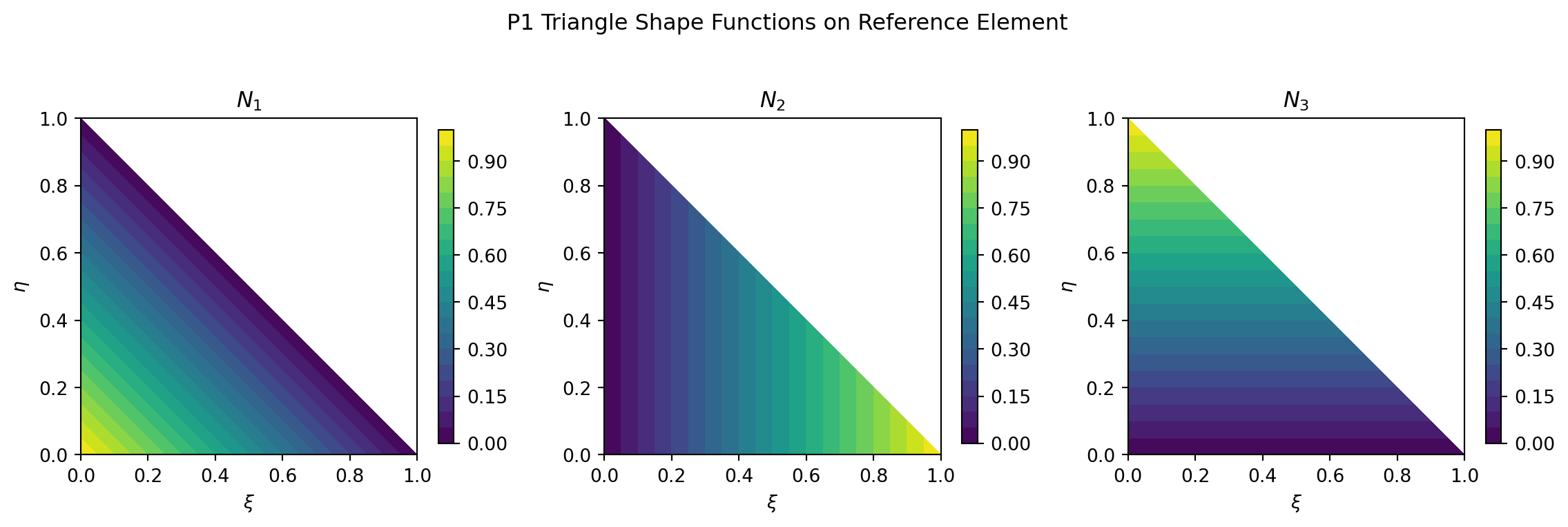
6.4 Visualizing Q1 Quadrilateral Shape Functions
fig, axes = plt.subplots(2, 2, figsize=(10, 9))
axes = axes.flatten()
xi_vals_q = np.linspace(-1, 1, 50)
eta_vals_q = np.linspace(-1, 1, 50)
XI_q, ETA_q = np.meshgrid(xi_vals_q, eta_vals_q)

for idx, (ax, N_sym) in enumerate(zip(axes, quad1.shape_functions)):
    N_fn = sp.lambdify((xi, eta), N_sym, "numpy")
    Z = N_fn(XI_q, ETA_q)
    c = ax.contourf(XI_q, ETA_q, Z, levels=20, cmap="viridis")
    ax.set_title(f"$N_{{{idx+1}}}$")
    ax.set_xlabel(r"$\xi$")
    ax.set_ylabel(r"$\eta$")
    ax.set_aspect("equal")
    plt.colorbar(c, ax=ax, shrink=0.7)

plt.suptitle("Q1 Quadrilateral Shape Functions on Reference Element")
plt.tight_layout()
plt.show()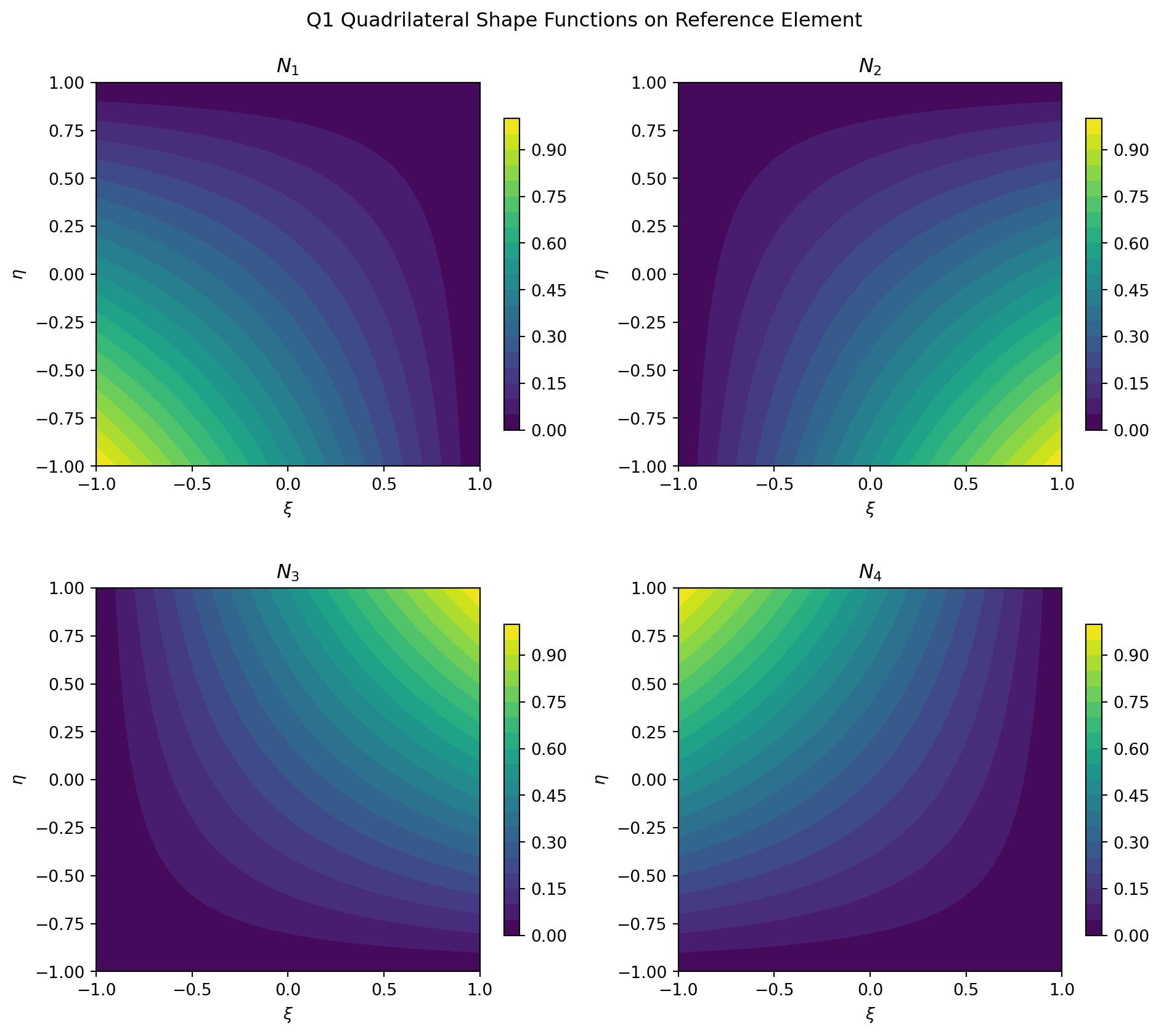
6.5 Exercise
Question: Verify the Kronecker delta property for the Q2 quadrilateral. For each node, evaluate all 9 shape functions and check that \(N_i(\text{node}_j) = \delta_{ij}\). Which shape function is the most “localized” (has the smallest support)?
# Exercise: Verify the Kronecker delta property for the Q2 quadrilateral.
# For each node, evaluate all 9 shape functions and check N_i(node_j) = delta_ij.