L09 — Damage Mechanics
Continuum Damage, Fracture, and Coupled Problems
Mohr-Coulomb Criterion
The Mohr-Coulomb criterion is the classical model for frictional materials (soils, rocks, concrete).
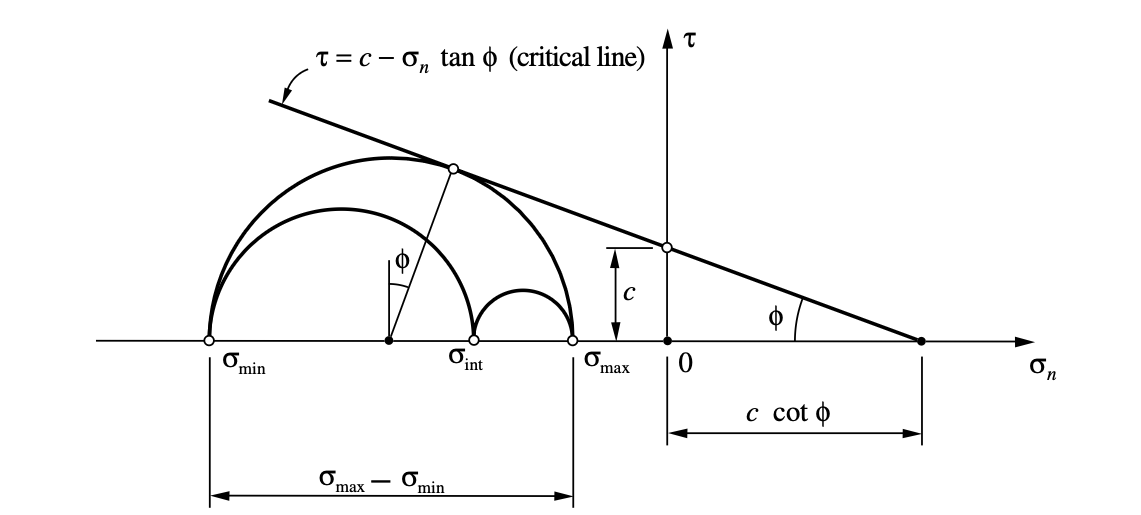
Physical Interpretation: Yielding occurs when shear stress on any plane reaches: \[\tau = c - \sigma_n\tan\phi\]
where: - \(\tau\) = shear stress on the failing plane - \(\sigma_n\) = normal stress on the failing plane - \(c\) = cohesion (material strength when \(\sigma_n = 0\)) - \(\phi\) = internal friction angle
This gives a linear failure envelope in \((\sigma_n, \tau)\) space.
Yield Function in Terms of Principal Stresses:
For principal stresses \(\sigma_1 \geq \sigma_2 \geq \sigma_3\): \[\Phi(\boldsymbol{\sigma}, c) = (\sigma_1 - \sigma_3) + (\sigma_1 + \sigma_3)\sin\phi - 2c\cos\phi = 0\]
Using invariants (with \(p\) = mean pressure, \(\theta\) = Lode angle, \(J_2, J_3\) = stress invariants): \[\Phi = \left(\cos\theta - \frac{\sin\theta\sin\phi}{\sqrt{3}}\right)\sqrt{J_2} + p\sin\phi - c\cos\phi = 0\]
Key Properties: - Non-smooth yield surface: hexagonal pyramid in principal stress space - Apex at \(p = c\cot\phi\) (tensile limit) - Generally non-associative flow rule (dilation angle \(\psi \neq \phi\)) - Hardening: cohesion becomes a function of accumulated plastic strain: \(c = c(\bar{\varepsilon}^p)\)
Mohr-Coulomb surface
Tresca Criterion
The Tresca yield criterion (pressure-insensitive version of M-C) states that plasticity begins when the maximum shear stress reaches a critical value:
\[\tau_{\max} = \frac{1}{2}(\sigma_{\max} - \sigma_{\min})\]
Yield Function: \[\Phi(\boldsymbol{\sigma}) = (\sigma_1 - \sigma_3) - \sigma_y(\bar{\varepsilon}^p) = 0\]
where \(\sigma_y(\bar{\varepsilon}^p)\) is the uniaxial yield stress (function of hardening variable \(\bar{\varepsilon}^p\)).
Yield Surface: A hexagonal prism in principal stress space (axis = hydrostatic line).
Multisurface Representation: Six yield surfaces based on principal stress pairs: \[\Phi_1 = \sigma_1 - \sigma_3 - \sigma_y, \quad \Phi_2 = \sigma_2 - \sigma_3 - \sigma_y, \quad \Phi_3 = \sigma_1 - \sigma_2 - \sigma_y, \ldots\]
Only one or two surfaces are active at a given stress state; the algorithm must identify the active subset.
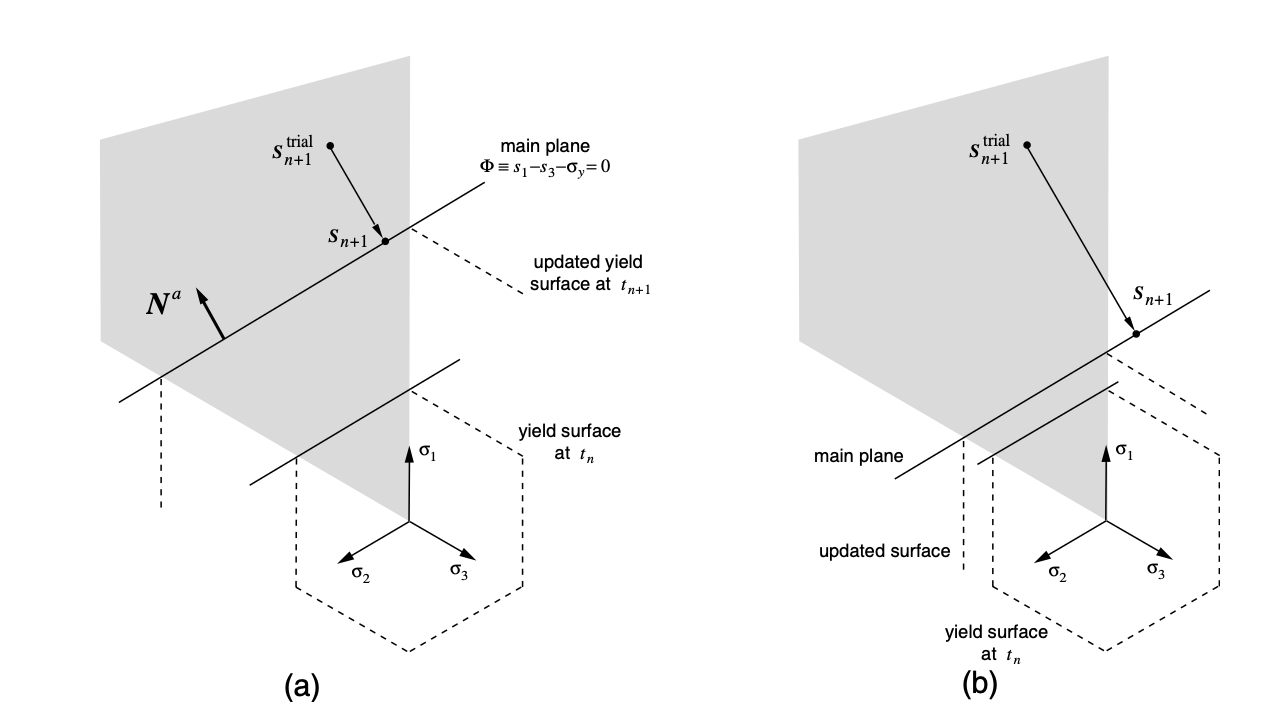
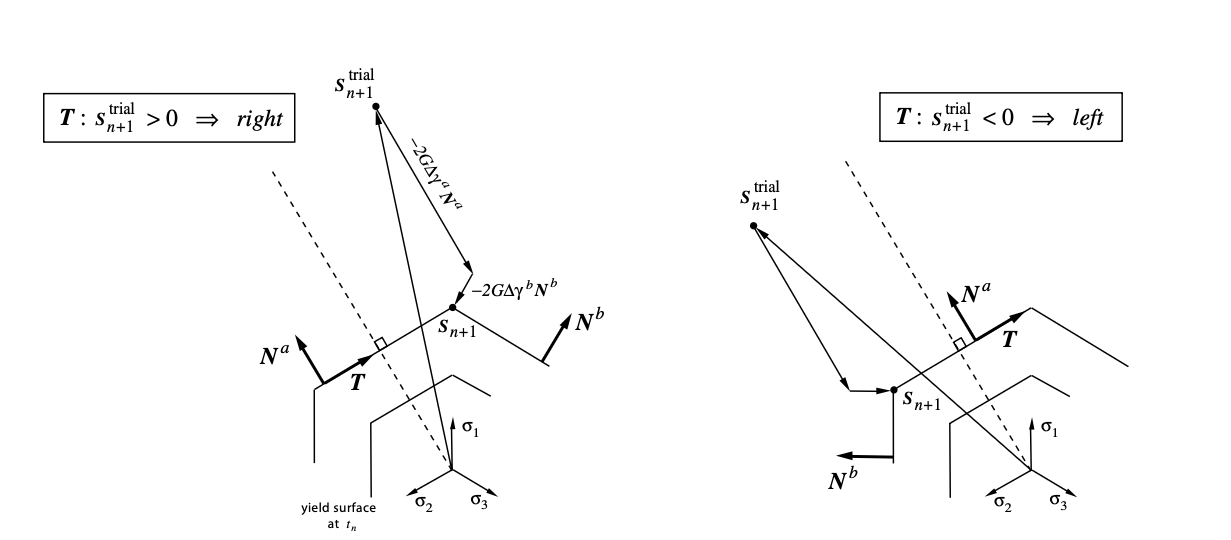
Return Mapping Procedure:
For a given principal stress ordering (\(\sigma_1 \geq \sigma_2 \geq \sigma_3\)), three cases arise:
- Main plane flow (\(\Phi_1\) only): one multiplier \(\Delta\gamma\)
- Updates: \(s_1 = s_{trial,1} - 2G\Delta\gamma\), \(s_3 = s_{trial,3} + 2G\Delta\gamma\), \(s_2\) unchanged
- Consistency: \(s_{trial,1} - s_{trial,3} - 4G\Delta\gamma - \sigma_y(\bar{\varepsilon}_{p,n} + \Delta\gamma) = 0\)
- Corner flow (two surfaces active, e.g., \(\Phi_1\) and \(\Phi_6\)): two multipliers \(\Delta\gamma_a, \Delta\gamma_b\)
- More complex stress updates and consistency conditions (system of 2 equations)
- Another corner (\(\Phi_1\) and \(\Phi_2\)): similar to case 2 but different geometry
The algorithm must determine which case applies and solve accordingly (often with iteration).
Drucker-Prager Criterion
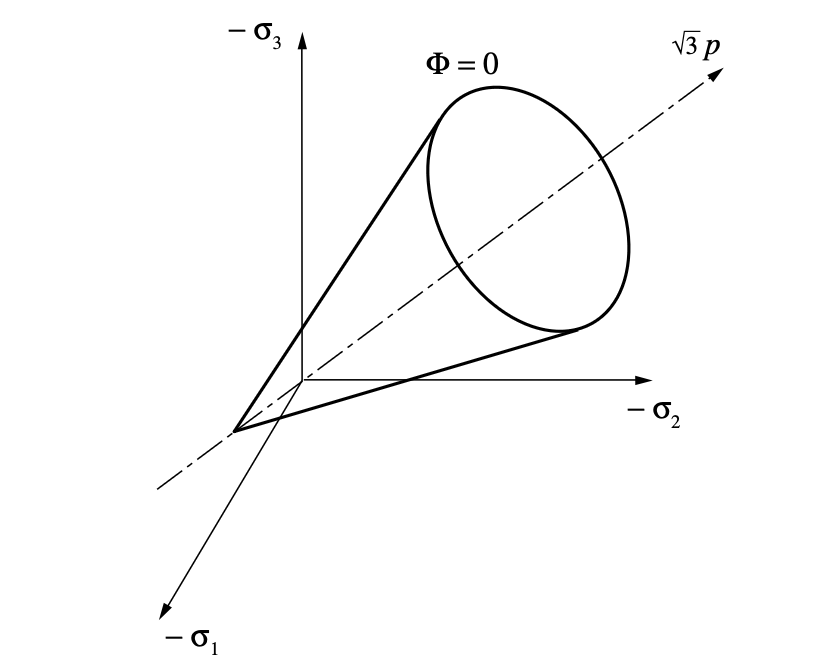
The Drucker-Prager (DP) criterion is a smooth approximation to Mohr-Coulomb, incorporating pressure into a von Mises-like framework.
Yield Function: \[f_\text{DP}(\boldsymbol{\sigma}, c) = \sqrt{J_2(\mathbf{s}(\boldsymbol{\sigma}))} + \eta\, p(\boldsymbol{\sigma}) - \xi\, c = 0\]
where: - \(\sqrt{J_2}\) = equivalent deviatoric stress (like von Mises) - \(p\) = hydrostatic pressure - \(\eta, \xi\) = material parameters chosen to fit Mohr-Coulomb - \(c = c(\bar{\varepsilon}^p)\) = cohesion (hardening variable)
Yield Surface: A circular cone in principal stress space (smooth, isotropic about hydrostatic axis).
Advantages over M-C: - Smooth (no corners) → simpler numerical implementation - No need for multisurface logic - Single elastic region identification
Flow Rule (Non-Associative):
The flow potential is: \[\Psi(\boldsymbol{\sigma}, c) = \sqrt{J_2(\mathbf{s})} + \bar{\eta} p\]
Flow vector: \[\mathbf{N} = \frac{\partial\Psi}{\partial\boldsymbol{\sigma}} = \frac{\mathbf{s}}{2\sqrt{J_2}} + \frac{\bar{\eta}}{3}\mathbf{I}\]
where the second term represents volumetric (dilatational) flow. The dilatancy parameter \(\bar{\eta}\) can differ from \(\eta\) in the yield function.
Return Mapping Algorithm:
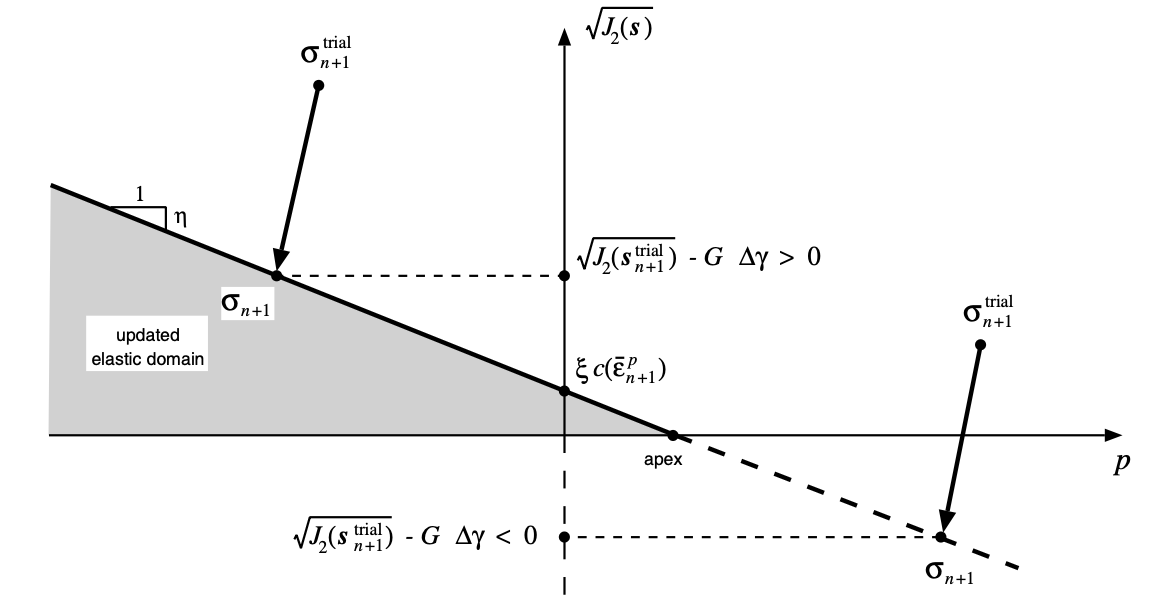
Two cases exist due to cone geometry:
- Return to smooth cone portion:
- Update deviatoric stress: \(\mathbf{s}_{n+1} = \left(1 - \frac{G\Delta\gamma}{\sqrt{J_2(s_{trial})}}\right) \mathbf{s}_{trial}\)
- Update mean pressure: \(p_{n+1} = p_{trial} - K\bar{\eta}\Delta\gamma\)
- Consistency condition gives scalar equation for \(\Delta\gamma\)
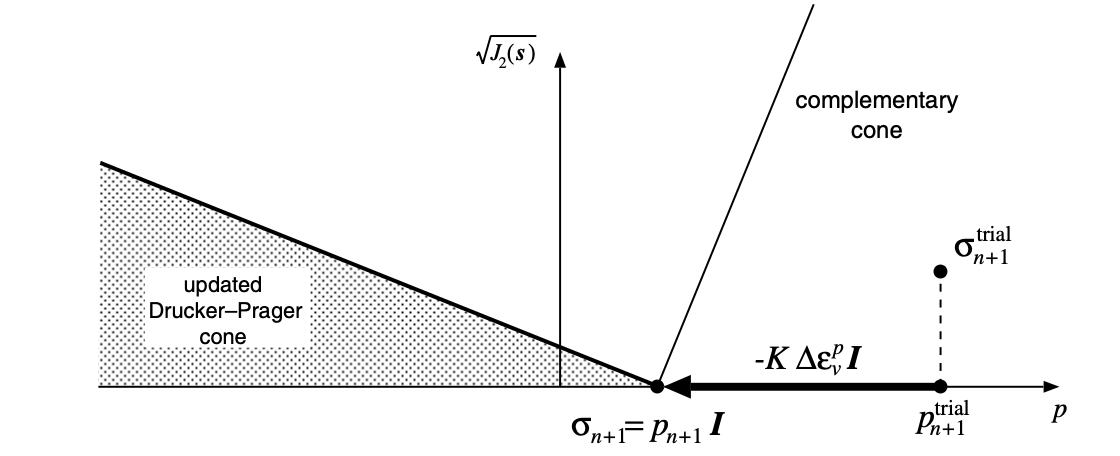
- Return to apex (when stress tries to enter the “forbidden” region):
- Deviatoric stress collapses: \(\mathbf{s}_{n+1} = 0\)
- Mean pressure determined from apex condition: \(p = \frac{\xi}{\eta}c\)
- Different scalar equation for volumetric plastic strain increment
The algorithm first attempts the smooth cone; if invalid, it applies the apex return.